


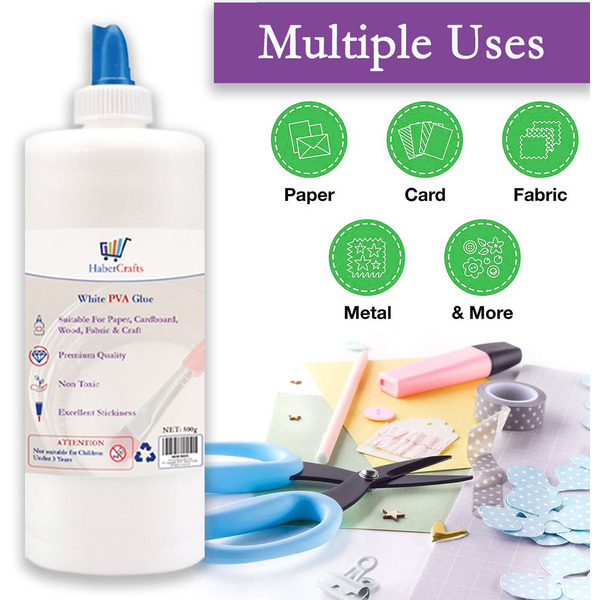
The most important tool for all fields of crafting and model making and home repairs work is PVA Glue which functions as an absolute requirement. Polyvinyl Acetate (PVA) serves as the fundamental component for numerous creative initiatives under its common names which include “white glue,” “school glue” and “wood glue.”
The ability to achieve professional results requires all users including teachers who equip classrooms and professional woodworkers and weekend DIYers to learn how to use this powerful adhesive. The guide will explain why HaberCrafts PVA glue stands as the best adhesive option while showing users effective methods to apply it in their upcoming projects.
What is PVA Glue?
PVA glue functions as an adhesive which uses water as its base and synthetic polymers as its main component. The adhesive has gained widespread use because it can penetrate porous materials such as paper and wood and fabric to create bonds which exceed the strength of the base materials.
People love this product because it starts as a milky white liquid but transforms into a clear finish which makes your project look clean and professional without showing any yellowing or residue.
Key Benefits of Using HaberCrafts PVA Glue
Choosing the right brand of adhesive matters. HaberCrafts PVA Glue is specifically formulated to meet the needs of diverse creators. Here are the primary benefits:
1. Child-Safe and Non-Toxic
Educational environments require their safety measures to become their highest priority. The PVA product from HaberCrafts provides safe use for children because it lacks toxic substances and acid materials. The product serves as the perfect solution for educational projects and sensory-based activities which involve making slime because it contains neither solvents nor phthalates.
2. Easy Cleanup
Crafting activities always result in unexpected messes. The glue can be removed from skin and clothing and brushes through the use of soap and water because it is designed as a water-based product which remains wet. The process of cleaning up after arts and crafts activities does not require any dangerous chemical substances.
3. Flexible Strength
PVA glue maintains its flexibility after curing while super glues develop brittle characteristics which cause them to break apart with time. The adhesive bond uses this property to expand and contract according to environmental factors which makes it suitable for binding books and working with fabric materials.
4. Versatile Application
The glue package includes a resealable cap which maintains freshness and a spreader cap which allows users to distribute glue evenly. The product enables users to apply contents directly from the bottle or to use a brush when working on larger areas.
Top Uses for PVA Glue in Crafts & DIY
Arts and Crafts in Schools
In classrooms, PVA glue is the “general-purpose” king. It is used extensively for:
- Paper and Cardboard: Creating 3D models and posters.
- Papier-Mâché: Mixed with water, the material produces a solid protective layer which forms for masks and sculptures.
- Slime Making: The substance possesses special chemical characteristics which enable it to create optimal stretchy slime when combined with activators.
Woodworking and Home Repairs
The specialized “yellow” wood glues provide dedicated performance, but professional-grade PVA glue serves as an excellent solution for handling light woodworking needs. The adhesive penetrates wood fibers to form a permanent bond when the wood pieces are pressed together under pressure. The product functions effectively to restore detached veneers and to repair broken trim and molding.
Bookbinding and Decoupage
PVA functions as an adhesive which preserves delicate paper materials because it remains acid-free and maintains a neutral pH balance. Bookbinders use it for spines because of its flexibility, while decoupage artists use it as both an adhesive and a sealant to protect their designs.
Expert Tips for Best Results
To achieve optimal results with your HaberCrafts adhesive, please follow these straightforward DIY guidelines.
- Surface Preparation: The surfaces must be clean and dry and dust-free while wood requires light sanding for better glue penetration.
- The “Varnish Coat”: PVA functions as a varnish according to this information. Mix a small amount of water with the product and then apply it with a brush to a finished craft project. It will dry to a clear, protective sheen.
- Clamping is Key: Use a clamp or heavy book to apply pressure on wood or thick card construction projects during the glue drying process. This method creates maximum adhesive bonds by forcing the glue into the material’s pores.
- Thin it Out: You can use water to dilute PVA until you achieve a “size” or primer solution which will improve adhesion for your upcoming layer.
Why Choose HaberCrafts?
HaberCrafts offers different glue packaging options which range from 250ml bottles that serve home hobbyists to 1-litre bottles and bulk packs that schools can purchase. Our formula keeps its freshness for extended periods which enables you to work on creative projects without interruption from dried-up bottles.
Our PVA glue delivers both dependable performance and safe usage for three different activities which include scale model construction, household item repairs and children’s artistic projects that use slime and papier-mâché.
Conclusion
The PVA glue product functions more than school glue because it serves as a reliable strong adhesive which every toolbox and craft cupboard should contain. The product establishes itself as the ideal choice for DIYers because it dries clear while maintaining flexibility and allowing for simple cleaning.
Are you prepared to begin your upcoming project? Visit HaberCrafts today to discover our selection of premium adhesive products and crafting materials which will enable you to express your artistic vision.
The video displays PVA glue’s bonding behavior with various materials while providing users with effective bonding techniques which they can use in their DIY projects.